
Refinance Calculator
Use this free refinance calculator to see in seconds whether refinancing your mortgage saves your money. Enter your current loan and up to three new loan options, and you get your new monthly payment, your monthly saving, and the exact month your closing costs pay for themselves. No account needed. No contact details asked. Your numbers stay in your browser.
Your current loan
Costs that apply to every loan
Option A
Option B
Option C
Compare options A, B, and C
| Option | Rate | Term | Monthly total | Monthly saving | Break even months | Total interest |
|---|
Payment schedule
First 12 months
| Month | Payment | Interest | Principal | Balance left |
|---|
Yearly summary
| Year | Interest paid | Principal paid | Balance left |
|---|
Balance chart
The chart shows how the loan balance falls over time.
How to read your schedule
Each row in the monthly schedule covers one month of the chosen loan. It shows the payment, the interest part, the principal part, and the balance left after that payment. Interest is highest early, when the balance is largest, so the principal part starts small and grows over time as the balance falls. In the sample, month 1 shows interest of $1,250 and principal of $360, leaving $299,640. By month 12, the balance left is $295,574.
The yearly summary adds up twelve months at a time, so you can see the pattern over a longer period. Year by year, interest falls and principal rises. Year 1 shows interest of $14,899 and principal of $4,426. Use the totals to compare options: lower total interest usually means a cheaper loan, but always check the monthly payment and the break even point too.
Run your own numbers in this refinance calculator and compare the true totals side by side before you decide.
How it works
Step 1: Enter your current loan
balance, rate, and years left
Step 2: Add up to three new loans
rate, term, and closing costs for each option
Step 3: Read your verdict
saving, break even, and schedule for each option, side by side
Worked example
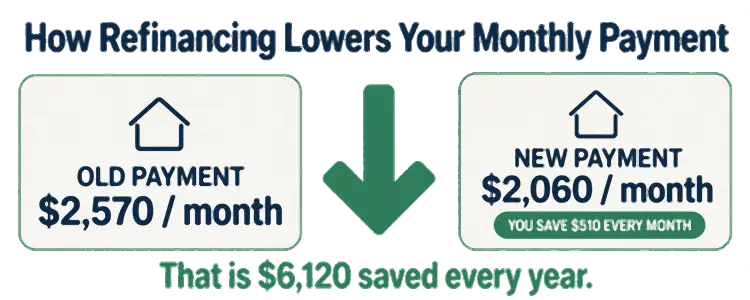
Example only, not a promise: a $300,000 balance at 7 percent with 25 years left, refinanced to 5 percent for 30 years, with $6,000 closing costs, $3,600 yearly tax, and $1,800 yearly insurance. The calculator shows about $2,570 old total, about $2,060 new total, about $510 saved each month, and break even in about 12 months. Your own numbers will differ.
What closing costs usually include
How much does it cost to refinance? The table below shows the usual closing cost items and their typical ranges in the United States.
| Cost item | What it covers | Typical range |
| Origination fee | Lender charge for processing and underwriting the new loan | 0.5% to 1% of the loan amount |
| Appraisal | Independent check of the home value for the lender | $300 to $600 |
| Title search and title insurance | Checks ownership history and protects the lender against title claims | $500 to $1,500 |
| Credit report | Lender check of your credit history | $25 to $75 |
| Recording fee | Local government record of the new loan | $50 to $300 |
| Settlement fee | Closing agent service for finalizing the paperwork | $200 to $600 |
Break even explained
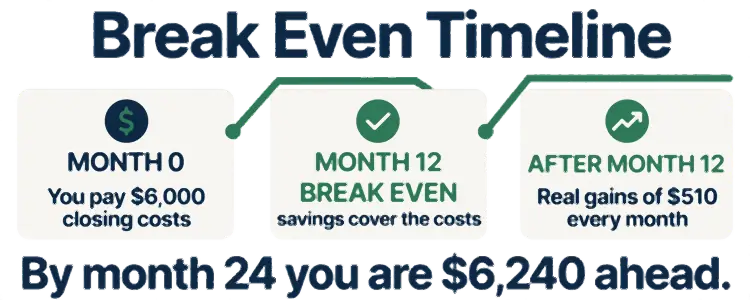
The break even point is the month when your total monthly savings equal the closing costs you paid. After that month, the savings are real gains. Before it, refinancing has cost you more than it saved.
What to do next
Your result is a starting point, not a final decision. These four steps turn it into a real plan.
Step 1: Get three lender quotes
Ask three lenders for their rate, term, and closing costs in writing. Real quotes beat any estimate.
Step 2: Run the numbers again
Put each quoted offer into the calculator as a separate scenario and compare the true totals side by side.
Step 3: Check your break even against your stay plan
If your break even month comes after you plan to move or sell, the refinance likely costs more than it saves.
Step 4: Talk to a licensed professional
Before you sign anything, confirm the figures with your lender and consider speaking with a licensed mortgage professional.
How accurate is this calculator?
Our calculator uses the standard loan amortisation formula that lenders use for principal and interest, then adds your own tax, insurance, and PMI figures to give your true total. Results are estimates. Your lender's exact figures can differ because rates, fees, and PMI rules vary by lender and by your credit profile. Treat the verdict as a guide for comparison, and confirm final numbers with your lender before deciding.
Run your own numbers before you decide. Compare the true monthly totals, the total interest, and the break even month for each option side by side, and check the stay verdict against the years you plan to stay. A lower rate only helps when the monthly saving beats the closing costs inside your stay. Use this refinance calculator to test each option with your real figures, then confirm the final numbers with your lender before you sign anything.
Frequently Asked Questions
What does this refinance calculator do?
It compares your current mortgage with up to three new loans and shows your new monthly payment, your monthly saving, your break even month, and your full payment schedule. It also adds tax, insurance, and PMI so you see your true total, not only principal and interest.
Should I refinance my mortgage?
Refinancing can help when the new rate is clearly lower, your monthly saving covers your closing costs well before you move or sell, and you plan to stay past your break even month. Use the stay horizon field to test your own plan. This tool gives estimates only, not financial advice.
How much does it cost to refinance?
Closing costs vary by lender and loan size and often fall between 2 percent and 5 percent of the loan amount. Enter your lender quoted costs item by item for an exact break even for your case.
What is the break even point?
The break even point is the month when your total monthly savings equal the closing costs you paid. After that month, the savings are real gains. Before it, refinancing has cost you more than it saved.
Do I need an account or contact details?
No. The calculator runs fully in your browser. Nothing you enter is sent or stored anywhere.
Conclusion
This refinance calculator compares your current loan with up to three new loans side by side, so the monthly saving, the break even month and the stay verdict tell you whether refinancing pays off for you. A lower rate only helps when the saving beats the closing costs inside the years you plan to stay.
Not financial advice: RefiClear is an educational tool. Results are estimates — confirm figures with your lender and consider speaking with a licensed mortgage professional before deciding.
Last updated: October 29, 2026